← Back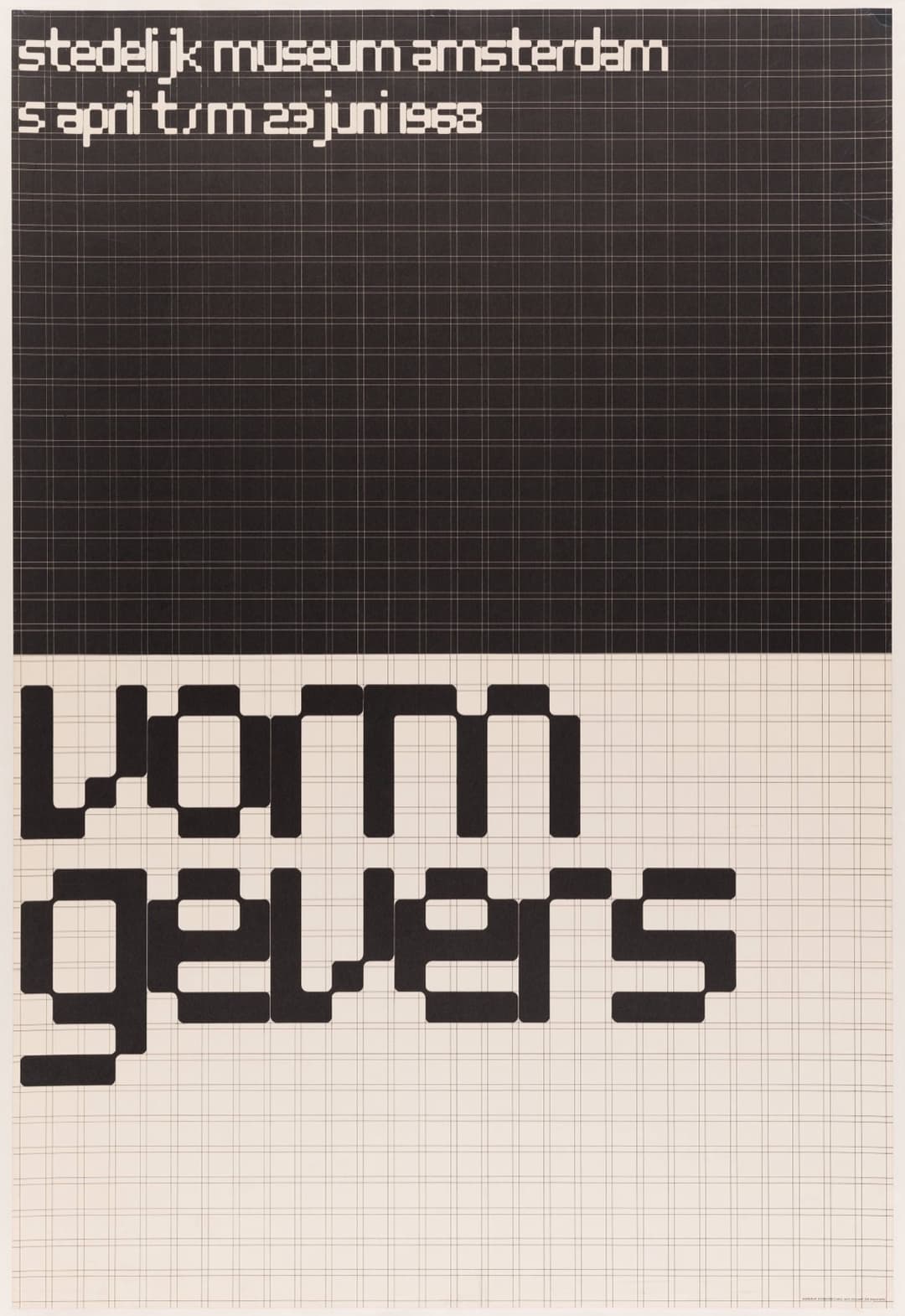
StructureOriginal
The grid, printed in plain sight.
Wim Crouwel was responsible for the graphic design of the Stedelijk Museum in Amsterdam from 1963 to 1985. He gave its posters and catalogues a common grid, strictly kept, and earned the nickname Mr. Gridnik.
Most of his posters keep the grid out of sight. Vormgevers, made for the museum’s 1968 exhibition of that name, prints it across the whole sheet and builds the letters from its cells. The red lines on the plate follow the poster’s own printed mesh, and the black field ends exactly halfway down.
A year earlier Crouwel had designed the New Alphabet for early computer typesetting, using only horizontal and vertical strokes because the cathode-ray screens of the time drew curves poorly. In both, the limits of the system became the style.
- Work with a constraint instead of against it, and it can become the style.
- Keep one grid across many works and it becomes recognisably yours.
- Let the system be stronger than any single piece made with it.